EveryENC


Banknote Collections
Let's Learn a Little History


The first paper issues of the Australian dollar were issued in 1966. The $1, $2, $10 and $20 notes had exact equivalents in the former pound notes. The $5 note was issued in 1967, the $50 was issued in 1973 and the $100 was issued in 1984.
Shortly after the changeover, substantial counterfeiting of $10 notes was detected. This provided an impetus for the Reserve Bank of Australia to develop new note technologies jointly with the Commonwealth Scientific and Industrial Research Organisation, culminating in the introduction of the first polymer banknote in 1988.
The Bahraini dinar was introduced in 1965, replacing the Gulf rupee at a rate of 10 rupees = 1 dinar. It was initially equivalent to 3⁄4 of a pound sterling (15 shillings).
Bahraini coins and notes were introduced at that time.
Initially, Abu Dhabi adopted the Bahraini dinar but changed to the dirham in 1973, with 1 dirham = 100 fils = 0.1 dinar.
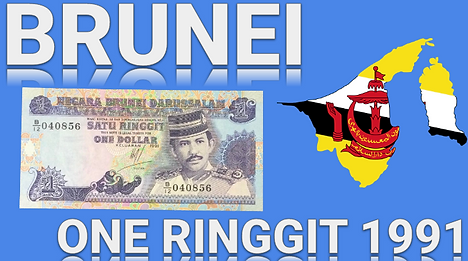
Third series – the post independence series. This series was gradually being replaced by the fourth series.
In 1989, the title on the paper money was changed to Negara Brunei Darussalam, the official name of the country, and the Malay term for “State of Brunei, Abode of Peace.” 10,000 dollar notes were introduced the same year. All notes bear the denomination in Malay (in both Rumi and Jawi) and in English.

The Bank of Central African States issued CFA franc Central Africa banknotes in 6 different denominations, including this 500 francs banknote Central African CFA (1992 to 2002 issue). They are part of the withdrawn Central African CFA franc banknotes series. The Bank of Central African States started issuing these 500 CFA franc Central Africa banknotes in 1992. They were withdrawn from circulation in 2002.

The 1992 Cook Islands 3 Dollar banknote with a pick number P-6 was issued by the Government of the Cook Islands to commemorate the 6th Festival of Pacific Arts that took place in Rarotonga on October 16- 27, 1992. On the banknotes obverse is a naked woman named Ina with a coconut in her hands, riding on a shark in the middle of the ocean with waves. The back of the note bears an overprint 6th FESTIVAL OF PACIFIC ARTS RAROTONGA COOK ISLANDS, OCTOBER 16 -27, 1992. The banknote is 150 x 75 mm in size and comes in green. Though it has no security threads or watermarks, it bears the signature of Thomas Davis who served as the Minister of Finance. This particular Cook Islands 3 dollar paper bill is in uncirculated condition.

This uncirculated 5 Costa Rican colon banknote is part of the Costa Rican series of banknotes that integrated more color and stronger security features to its banknotes. This note is signed by Central Bank of Costa Rica Board of Directors President Hernan Garron Salazar and Bank Manager Claudio A. Volio Guardia. Its obverse side contains two Guarianthe skinneri orchidsthe national flower of Costa Rica, and Rafael Anselmo Jose Yglesias Castro, the 16th president of Costa Rica from 1894 to 1902. Its reverse side depicts Aleardo Villas 1897 painting Allegory of Coffee and Bananas found in the Teatro Nacional. Security features of the note are a solid security thread and a BCCR CINCO 5 watermark. The note is 156 mm long and 67 mm wide.

On August 31, 1934, the Central Reserve Bank of El Salvador put into circulation the first uniform family of banknotes, replacing banknotes issued by the Banco Agricola Comercial, the Banco Occidental, and the Banco Salvadoreño: the first banknote family consisted of six denominations: 1, 2, 5, 10, 25 and 100 colones. The Central Reserve Bank later authorised the first 50-colón banknotes on May 3, 1979, and the first 200-colón banknotes on April 18, 1997. The last two-colón banknotes were authorized on 24 June 1976, followed by the one-colón banknote on 3 June 1982.
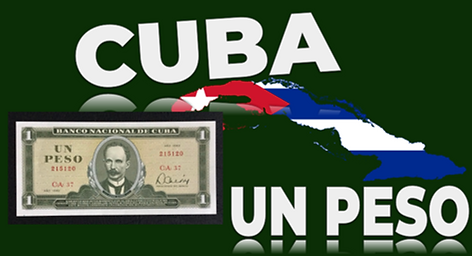
The 1961 bank notes were demonetized on May 1, 2002. 200-, 500-, and 1000-peso notes were (re-)introduced in 2015. Banknotes currently in circulation are 1, 3, 5, 10, 20, 50, 100, 200, 500, and 1000 pesos. This banknote series is the only valid currency after the 2021 monetary unification when the convertible peso was retired.

On 23 July 1945, notes were introduced by the State Bank of Ethiopia in denominations of 1, 5, 10, 50, 100 and 500 birr. The National Bank of Ethiopia was established by imperial proclamation 207 of 27 July 1963, and began operation on 1 January 1964. The National Bank of Ethiopia took over note production in 1966 and issued all denominations except for the 500 birr.

The Banco de España issued Spanish Peseta banknotes in 12 different denominations, including this 200 Spanish Pesetas banknote (Leopoldo Garcia-Alas). They are part of the Spanish Peseta banknotes series. The Banco de España started issuing these 200 Spanish Peseta banknotes in 1980. They were withdrawn from circulation in 2002.

The Suomen Pankki issued Finnish Markka banknotes in 9 different denominations, including this 5 Finnish Markkaa banknote (1963). They are part of the Finnish Markka banknotes series. The Suomen Pankki started issuing these 5 Finnish Markka banknotes in 1963. They were withdrawn from circulation in 1994.

On 2 October 1995, the government of Eduard Shevardnadze replaced the provisional coupon currency with the Lari, at a rate of one million to one. It has remained fairly stable since then.

At the outbreak of World War I, Gibraltar was forced to issue banknotes to prevent paying out sterling or gold. These notes were issued under emergency wartime legislation, Ordinance 10 of 1914. At first, the typeset notes were signed by hand by Treasurer Greenwood, though he later used stamps. The notes bore the embossed stamp of the Anglo-Egyptian Bank Ltd. and circulated alongside British Territory notes. The 1914 notes were issued in denominations of 2/-, 10/-, £1, £5 and £50. The 2/- and £50 notes were not continued when a new series of notes was introduced in 1927. The 10/- note was replaced by the 50p coin during the process of decimalization. In 1975, £10 and £20 notes were introduced, followed by £50 in 1986. The £1 note was discontinued in 1988.

The Bank of Greece issued Greek Drachma banknotes in 10 different denominations, including this 50 Greek Drachmas banknote (Poseidon). They are part of the Greek Drachma banknotes series. The Bank of Greece started issuing these 50 Greek Drachma banknotes in 1978. They were withdrawn from circulation in 1986.

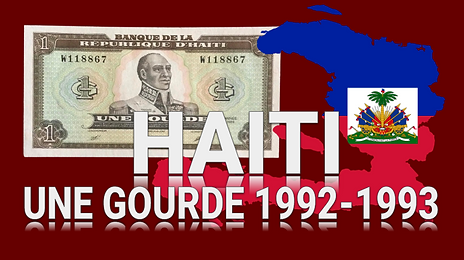
The first banknotes were issued by the Central Bank of Guatemala in denominations of 1, 2, 5, 10, 20 and 100 quetzales, with 1⁄2 quetzal notes added in 1933. In 1946, the Bank of Guatemala took over the issuance of paper money, with the first issues being overprints on notes of the Central Bank. Except for the introduction of 50 quetzal notes in 1967, the denominations of banknotes remained unchanged until 1⁄2 and 1 quetzal coins replaced notes at the end of the 1990s.
The Haitian gourde is the national currency for the Republic of Haiti. The name, gourde, is French, though it is based on an old Spanish currency called gordos. The Haitian gourde subdivides into 100 centimes, and the symbol G represents the currency. The currency code is HTG, and the currency's value floats against other currencies.

In 1981, the Icelandic krona was revalued, due to high inflation, with 100 old krona (ISJ) being worth 1 new krona (ISK) and a new 500 krona banknote was first put into circulation in 1981. The 1000 krona was put into circulation in 1984 and the 5000 krona in 1986. The 2000 krona banknote was put into circulation in 1995 but never became very popular. The 10,000 krona banknote was put into circulation in 2013.


On 8 September 1969, banknotes of 50 cents (5 shillings), $1 (10 shillings), $2 (£1), and $10 (£5) were introduced. The $5 note was introduced on 20 October 1970, followed by the $20 in June 1976, when the 50 cent note was replaced by a coin. $100 notes were added on 2 December 1986, followed by $50 notes on 27 July 1988. The $2 note was dropped in 1994, whilst the $1 note was replaced by a coin in 1990. In 1994, coins replaced the $5 notes and $500 notes were introduced. In 1999, $10 coins replaced notes, whilst, in 2000, $20 coins replaced the notes and $1000 notes were introduced.
In 1964, the government introduced North Yemen's first paper money, 1 and 5 rial notes. These were followed by 10 and 20 buqsha in 1966, 10 rial in 1967 and 20 and 50 rial in 1971. In 1973, the Central Bank of Yemen took over the issuance of paper money, introducing notes for 1, 5, 10, 20 and 50 rial. 100 rial notes were introduced in 1975.

Cambodian currency - the riel - appeared in 1955, when it replaced the formerly used Indochinese piastres. During the government of Pol Pot in 1975-1979 the monetary circulation and the banking system were dismissed; all that restored by 1979. 1 riel equals 100 cents.


In 1979, banknotes were introduced in denominations of 1, 5, 10, 20, 50 and 100 kip. 500 kip notes were added in 1988, followed by 1000 kip in 1992, 2000 and 5000 kip in 1997, 10,000 and 20,000 kip in 2002 and 50,000 kip on January 17, 2006 (although dated 2004). On November 15, 2010 a 100,000 kip banknote was issued to commemorate the 450th anniversary of the founding of the capital, Vientiane, and the 35th anniversary of the establishment of the Lao People's Democratic Republic.
The Banque du Liban (Bank of Lebanon) was established by the Code of Money and Credit on 1 April 1964. On 1 August 1963 decree No. 13.513 of the "Law of References: Banque Du Liban 23 Money and Credit" granted the Bank of Lebanon the sole right to issue notes in denominations of LL1, LL5, LL10, LL25, LL50, LL100, and LL250, expressed in Arabic on the front, and French on the back. Higher denominations were issued in the 1980s and 1990s as inflation drastically reduced the currency's value.
In 1993, notes for 500 ariary and 5000 ariary were introduced which bore the ariary denominations in numerals as well as the franc denominations (2500 and 25,000) in smaller numerals. However, in 1998, these notes were replaced by new issues which only gave the franc denominations in numerals.
In 2003–2004, new notes were introduced in denominations of 100, 200, 500, 1000, 2000, 5000 and 10,000 ariary. These notes also bear the franc denominations on notes up to 1000 ariary (500, 1000, 2500, 5000) in very small numerals.
50 tambala notes were last issued in 1986, with the last 1 kwacha notes printed in 1992. In 1993, 50 kwacha notes were introduced, followed by 100 kwacha in 1993, 200 kwacha in 1995, 500 kwacha in 2001 and 2000 kwacha in November 2016 to ease desperate cash shortages.


In 1945, the Majlis of the Maldives (Parliament) passed bill number 2/66 on the "Maldivian Bank Note". Under this law, banknotes for 1⁄2, 1, 2, 5 and 10 rufiyaa were printed and put into circulation on 5 September 1948.
In 1951, 50 and 100 rufiyaa banknotes were introduced. The current series of banknotes was issued in 1983 in denominations of 2, 5, 10, 20, 50 and 100 rufiyaa. 500-rufiyaa banknotes were added in 1990, with the 2-rufiyaa replaced by a coin in 1995.
Production of 1-peso notes ceased in 1970, followed by 5 pesos in 1972, 10 and 20 pesos in 1977, 50 pesos in 1984, 100 pesos in 1985, 500 pesos in 1987 and 1,000 pesos in 1988. 5,000-pesos notes were introduced in 1980, followed by 2,000 pesos in 1983, 20,000 pesos in 1985, 50,000 pesos in 1986 and 100,000 pesos in 1991.

Like coins, the tögrög banknotes were very similar to the Soviet ruble during the Mongolian People's Republic era. The similarities included color theme, overall design, and the lineup of the denominations, which were 1, 3, 5, 10, 25, 50, 100 tögrög unless stated otherwise.


The notes were changed slightly in 1981 due to a change of printer (from De La Rue to Bradbury, Wilkinson & Co.)—the most noticeable difference being the portrait based upon a photograph by Peter Grugeon, in which Queen Elizabeth II is wearing Grand Duchess Vladimir's tiara and Queen Victoria's golden jubilee necklace. The $50 note was added in 1983 to fill the long gap between the $20 and the $100 notes. $1 and $2 notes were discontinued in 1991 after being replaced with coins.
The Kobo
In 1973 the kobo had five denominations namely 1/2k, 1k, 5k, 10k and 25k. In 1989 50K and N1 notes were changed to coins. In recent times the kobo coins have been phased out as the value can no longer purchase items.

