EveryENC


Coin Collections
Let's learn a little history

Benin, officially the Republic of Benin (formerly known as Dahomey), is a country in West Africa. It is bordered by Togo to the west, Nigeria to the east, Burkina Faso to the north-west, and Niger to the north-east. The majority of its population lives on the small southern coastline of the Bight of Benin, part of the Gulf of Guinea in the northernmost tropical portion of the Atlantic Ocean.
The schilling was the official currency of Austria from 1925 to 1938 and from 1945 to 1999. The official currency symbol: S or öS. The first schilling was established in 1924, after the pronouncement of the Schilling Act. The following year the Oesterreichische Nationalbank issued coins in denominations of 1, 2, 10 groschen, and ½ and 1 schilling, followed by 5 groschen in 1931, 50 groschen, and 1 and 5 schilling in 1934.


The riel (/riˈɛl/; Khmer: រៀល, riĕl [riːəl]; sign: ៛; code: KHR) is the currency of Cambodia. There have been two distinct riel, the first issued between 1953 and May 1975. Between 1975 and 1980 the country had no monetary system. A second currency, also named "riel", has been issued since 20 March 1980. Since the 1990s citizens have used the riel alongside the U.S. dollar at the well-known rate of 4,000 KHR/USD for retail payments.
The Bonito is a large predatory fish that may or may not be a tuna. Many countries dispute the marketing of bonito as tuna. Regardless, it is an important food source in the Cook Islands.


In 1962, cupro-nickel 20 and 40 centavos were introduced, followed, in 1963, by aluminium 1 and 5 centavos. In 1969, aluminium 20 centavos were introduced, followed by aluminium 2 centavos and brass 1 peso in 1983. Cupro-nickel 3 peso coins were introduced in 1990, with brass-plated-steel 1 peso and nickel-clad-steel 3 peso coins following in 1992.
This beautifully illustrated cover is an official issue from World Wide Fund for Nature, WWF. It features The European Mouflon which can be found among the cliffs of the Mediterranean islands of Sardinia, Corsica and Cyprus.

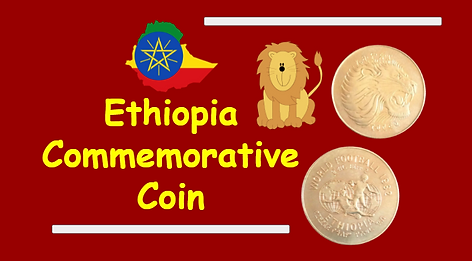
Here is a beautiful and striking authentic Ethiopia 2 Birr 1982 World Championship Soccer Commemorative. The stunning and amazing design of this uncirculated copper-nickel crown displays a fantastic lion design on the obverse, and two athletes competing on the reverse. The Ethiopia national football team, nicknamed "Walias" after the Walia ibex, represents Ethiopia in association football and is presided over by the Ethiopian Football Federation, the governing body for football in Ethiopia.
Interesting commemorative issue dedicated to the World Championship of Football in 1982 with crocodile in attractive condition. CHI in a circle on Obv. is for Chiasso, place of mintage in Switzerland.


Preussen (Preußen in German and as written on the vessel) (PROY-sin) was a German steel-hulled, five-masted, ship-rigged sailing ship built in 1902 for the F. Laeisz shipping company and named after the German state and kingdom of Prussia. It was the world's only ship of this class with five masts carrying six square sails on each mast. Until the 2000 launch of Royal Clipper, a sail cruise liner, she was the only five-masted full-rigged ship ever built.
The Russian ruble or rouble (Russian: рубль rublʹ; symbol: ₽, руб; code: RUB) is the official currency of the Russian Federation, and unofficially used in the two partially recognised republics of Abkhazia and South Ossetia and the two unrecognised republics of Donetsk and Luhansk. The ruble is subdivided into 100 kopeks (sometimes written as kopecks or copecks; Russian: копе́йка kopeyka, plural: копе́йки kopeyki).


The first Sahrawi pesetas were minted in 1990, but they were not adopted as the national coin of Western Sahara until 1997. As this territory is mostly controlled by Morocco, the circulating currency in that part of the country is the Moroccan dirham, with Algerian dinars and Mauritanian ouguiyas circulating alongside the Sahrawi peseta in the Sahrawi refugee camps and the SADR-controlled part of Western Sahara.
The coconut crab (Birgus latro) is a species of terrestrial hermit crab, also known as the robber crab or palm thief. It is the largest terrestrial arthropod in the world, with a weight of up to 4.1 kg (9 lb). It can grow to up to 1 m (3 ft 3 in) in width from the tip of one leg to the tip of another. It is found on islands across the Indian Ocean, and parts of the Pacific Ocean as far east as the Gambier Islands and Pitcairn Islands, similar to the distribution of the coconut palm; it has been extirpated from most areas with a significant human population, including mainland Australia and Madagascar.

Second shilling
In 1987, copper-plated-steel 1- and 2-shilling and stainless-steel five- and ten- shilling coins were introduced, with the five- and ten-shilling curved-equilateral heptagonal in shape. In 1998, coins for 50, 100, 200 and 500 shillings were introduced. Denominations currently circulating are 1, 2, 5, 10, 50, 100, 200, 500, and 1,000 shillings.

This is a record of Turkey's results at the FIFA World Cup. The FIFA World Cup, sometimes called the Football World Cup or the Soccer World Cup, but usually referred to simply as the World Cup, is an international association football competition contested by the men's national teams of the members of Fédération Internationale de Football Association (FIFA), the sport's global governing body. The championship has been awarded every four years since the first tournament in 1930, except in 1942 and 1946, due to World War II.


Coins were first struck in 1992 for the new currency but were not introduced until September 1996. Initially coins valued between 1 and 50 kopiyky were issued. In March 1997, 1 hryvnia coins were added. Since 2004 several commemorative 1 hryvnia coins have been struck.
In October 2012 the National Bank of Ukraine announced that it was examining the possibility of withdrawing the 1- and 2-kopiyky coins from circulation. The coins had become too expensive to produce compared to their nominal value. 1- and 2-kopiyky coins were not produced after 2013, but remained in circulation until 1 October 2019.
Uruguay obtained monetary stability in 1896, based on the gold standard. This favorable state of affairs ended after World War I. An unsettled period followed. Economic difficulties after World War II produced inflation, which became serious after 1964 and continued into the 1970s.
The peso was replaced on 1 July 1975 by the nuevo peso (new peso; ISO 4217 code: UYP) at a rate of 1 new peso for 1000 old pesos. The nuevo peso was also subdivided into 100 centésimos.
After further inflation, the peso uruguayo (ISO 4217 code: UYU) replaced the nuevo peso on March 1, 1993, again at a rate of 1 new for 1000 old.


The 1994 FIFA World Cup was the 15th FIFA World Cup, the world championship for men's national soccer teams. It was hosted by the United States and took place from June 17 to July 17, 1994, at nine venues across the country. The United States was chosen as the host by FIFA on July 4, 1988. Despite soccer's relative lack of popularity in the host nation, the tournament was the most financially successful.
The Susan B. Anthony dollar is a United States dollar coin minted from 1979 to 1981 when production was suspended due to poor public acceptance, and then again in 1999. Intended as a replacement for the larger Eisenhower dollar, the new smaller one-dollar coin went through testing of several shapes and compositions, but all were opposed by the vending machine industry, a powerful lobby affecting coin legislation. Finally, a round planchet with an eleven-sided inner border was chosen for the smaller dollar.

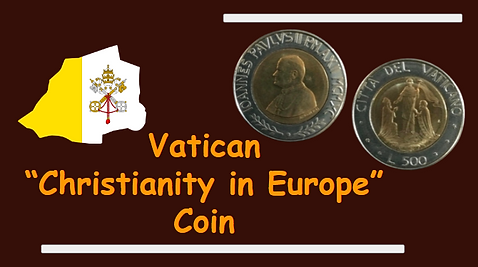
The theme of this 1990 Vatican City 500 lira coin is the importance of Christianity in Europe.
Historians believe that St. Paul wrote his first epistle to the Christians of Thessaloniki (Thessalonians) around AD 52. His Epistle to the Galatians was perhaps written even earlier, between AD 48 and 50. Other epistles written by Paul were directed to Christians living in Greece (1 Corinthians, 2 Corinthians, Philemon, Philippians, 2 Thessalonians) and Rome (Romans) between the 50s and 70s of the first century.

Vanuatu's first post-colonial coin was a 50 vatu coin introduced in 1981 and commemorated independence. It was struck in cupro-nickel like previous issues and was released into circulation, though originally its release was targeted more towards collectors. Shortly thereafter, in 1983, 1, 2, 5, vatu coins were released in aluminum bronze and 10, 20, and 50-vatu coins were introduced in cupro-nickel, replacing the coinage of the New Hebrides Franc as the new circulation currency.

The Venezuelan bolívar is the official currency of Venezuela. Named after the hero of Latin American independence Simón Bolívar, it was introduced following the monetary reform in 1879, before which the venezolano was circulating. Due to its decade-long reliance on silver and gold standards, and then on a peg to the United States dollar, it was considered among the most stable currencies and was internationally accepted until 1983, when the government decided to adopt a floating exchange rate instead.
After Vietnam was reunified, the đồng was also unified, on 3 May 1978. One new đồng equalled one Northern đồng or 0.8 Southern "liberation" đồng.
On 14 September 1985, the đồng was revalued, with the new đồng worth 10 old đồng. This started a cycle of chronic inflation that continued through much of the early 1990s.
Commemorative coins in copper, brass, copper-nickel, silver, and gold have been issued since 1986, but none of these have ever been used in circulation.


Coins were issued in 1993 in denominations of 1, 2, 5, 10 and 50 dinara struck in nickel-brass, and 100 dinara struck in brass. Brass 500 dinara coins were also struck but not issued, most being remelted. The design of these coins was similar to that of coins of the fifth dinar, except that the sixth dinar coins bore the state title "FR Yugoslavia" (SR Jugoslavija in Latin and СР Југославија in Cyrillic).

